
Walkie Talkie MCMC License Malaysia: What Businesses Must Know
Understand MCMC licensing, SIRIM certification, frequency permits, and legal requirements for walkie talkies in Malaysia.
7 min readlicenseMCMClegal
MCMC Compliance
Walkie Talkie MCMC License Malaysia: What Businesses Must Know
Understand MCMC licensing, SIRIM certification, frequency permits, and legal requirements for walkie talkies in Malaysia.
85%
Readiness score based on compliance and setup requirements
Compliance90%
Setup Time75%
Cost Clarity80%
Documentation95%
LLicenseMCMC requirements and SIRIM certification
FFrequencyApproved bands and interference management
CComplianceLegal obligations and penalty avoidance
DDocumentationRequired records and audit trails
MCMC Compliance
Walkie Talkie MCMC License Malaysia: What Businesses Must Know
MalaysiaBusinessCompliance
Compliance Level
85%
License Timeline
Apply
Approve
Risk Areas
Low Risk
Medium Risk
High Risk
01Check RequirementsVerify MCMC rules
02Apply LicenseSubmit to MCMC
03Get CertifiedSIRIM type approval
04Deploy RadiosInstall and test
05Maintain RecordsAudit compliance
Quick answer
Accepted section visual for Walkie Talkie MCMC License Malaysia: What Businesses Must Know
In Malaysia, walkie talkie usage falls under the Malaysian Communications and Multimedia Commission (MCMC) regulations. Businesses using professional two-way radios on regulated frequencies must obtain proper licenses and ensure their equipment carries SIRIM certification. License-free PMR446 radios (0.5W, 446 MHz) do not require a license for personal or light commercial use, but any radio operating on MCMC-assigned business frequencies or exceeding PMR446 power limits requires an Apparatus Assignment from MCMC.
The key legal framework is the Communications and Multimedia Act 1998 (Act 588) and its subsidiary regulations. Non-compliance can result in fines up to RM500,000 and imprisonment up to 5 years. For most Malaysian businesses running security teams, construction crews, event operations, or plant maintenance, the practical path is: verify your radio type and frequency, apply for MCMC Apparatus Assignment if needed, ensure SIRIM type approval, and maintain documentation for audit purposes.
Key requirements
MCMC regulates radio communications equipment through several layers of requirements. Understanding which apply to your operation saves time and avoids penalties.
1. Apparatus Assignment (AA) Required for any radio transmitter operating on MCMC-regulated frequencies. The AA specifies the frequency, power limit, and operational area. Application is submitted through MCMC’s online portal with supporting documents including company registration, frequency justification, and equipment specifications.
2. SIRIM Type Approval All telecommunications equipment sold or used in Malaysia must be certified by SIRIM QAS International. The certification confirms the device meets Malaysian technical standards for electromagnetic compatibility, RF output, and safety. Look for the SIRIM label or certification number on the device or packaging.
3. Frequency Allocation MCMC allocates specific frequency bands for different services. Common business bands include VHF (136-174 MHz) and UHF (400-470 MHz). The exact frequency depends on your location, number of users, and interference environment. MCMC may assign different frequencies for Kuala Lumpur vs. Johor Bahru operations.
4. License-Free PMR446 For small teams (typically under 10 users) with short-range needs, PMR446 radios at 0.5W on 446.0-446.2 MHz require no license. However, these are limited to 0.5W output and 16 fixed channels. They are not suitable for multi-site operations, indoor penetration through concrete, or environments with RF interference.
Compliance checklist
Use this checklist to verify your walkie talkie compliance status before deployment or audit:
Item
Required
Status
Notes
Apparatus Assignment
Yes (professional radios)
□ Pending □ Approved
Apply via MCMC portal
SIRIM Type Approval
Yes (all radios)
□ Verified □ Missing
Check label/cert number
Frequency Assignment
Yes (professional)
□ Assigned □ Pending
Match to operational area
Equipment Register
Recommended
□ Maintained □ Missing
Serial numbers, models, dates
User Training Records
Recommended
□ Documented □ Missing
Basic radio operation and rules
Renewal Tracking
Yes (AA expires)
□ System in place □ Ad-hoc
Calendar alerts for renewals
For businesses with multiple sites or large fleets, consider designating a compliance officer responsible for tracking renewal dates, regulatory updates, and equipment registers. MCMC regulations and frequency allocations can change, so an annual compliance review is advisable.
When rental makes sense
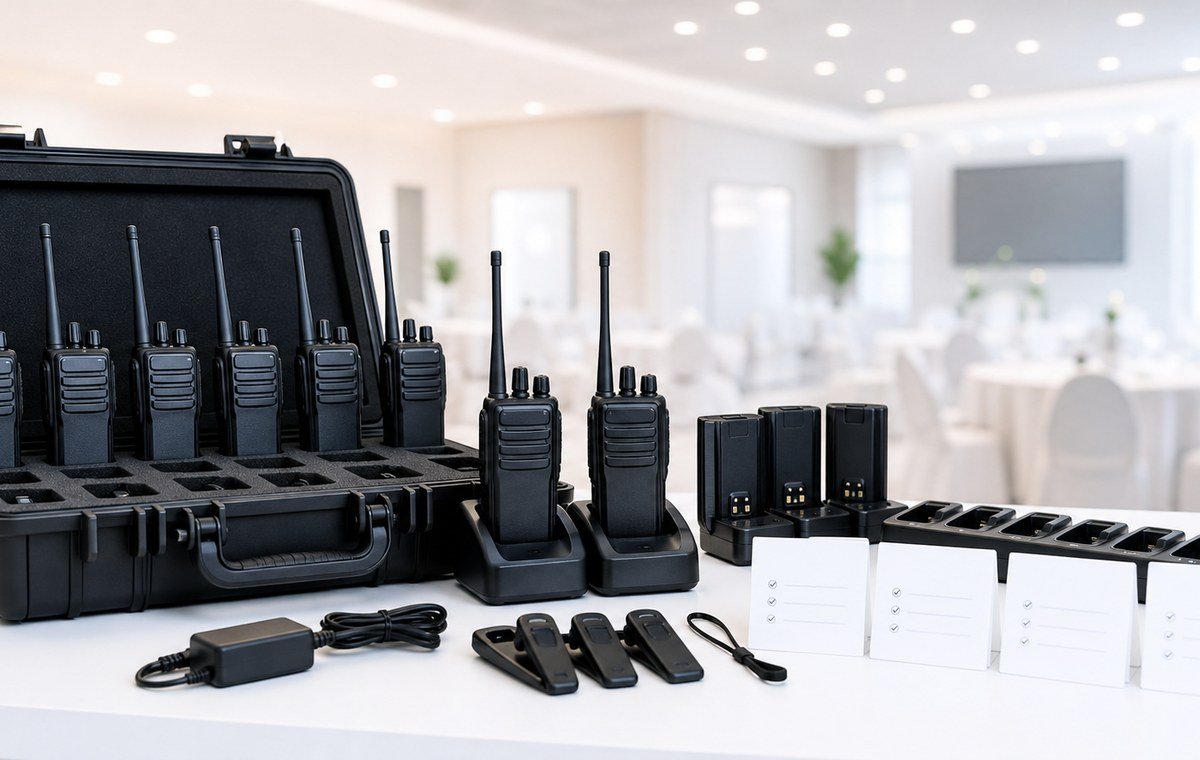
Renting walkie talkies from a licensed provider like Octogen shifts the compliance burden to the rental company. This is the practical choice for:
Short-term projects — Construction phases, event setups, or seasonal operations where the duration is under 6 months.
Variable team sizes — Security details or event crews where headcount changes weekly and purchasing a fleet creates idle inventory.
First-time compliance — Teams new to MCMC regulations who want to see how radios perform before committing to a purchase and license application.
Multi-site trials — Testing coverage across different locations before deciding on permanent frequency assignments.
Octogen rental units come with verified SIRIM certification and MCMC-compliant frequencies. The rental agreement includes equipment maintenance, battery replacement, and technical support, reducing the operational overhead for your team.
When purchase makes sense
Purchasing walkie talkies is the better long-term choice for:
Permanent operations — Manufacturing plants, warehouses, or facilities where radios are daily tools for years.
Custom programming — Operations needing specific channel plans, privacy codes, or integration with existing systems.
Cost amortization — For fleets over 15 units, purchase cost per month drops below rental rates after approximately 8-12 months of use.
Asset control — Organizations with strict asset management policies or capital expenditure cycles.
When purchasing, verify the supplier provides SIRIM-certified equipment and assists with MCMC Apparatus Assignment application. Some suppliers bundle the license application service with the equipment purchase. Budget approximately RM200-500 per radio for the unit, plus MCMC fees for frequency assignment (varies by location and number of frequencies).
Real Deployment Notes
Document everything
Keep records of all licenses, certifications, and compliance checks. MCMC may request documentation during inspections or interference investigations.
Review annually
MCMC regulations and frequency allocations can change. Review compliance yearly and check for regulatory updates on the MCMC website.
Assign responsibility
Designate a team member to track renewal dates, equipment registers, and regulatory updates. Do not leave compliance to memory or ad-hoc checks.
licenseMCMClegal
Common Customer Questions
Do I need a license for walkie talkies in Malaysia?
This depends on the frequency and power output. License-free PMR446 radios (0.5W, 446 MHz) do not require a license for personal or light commercial use. However, professional radios operating on MCMC-regulated frequencies or exceeding PMR446 power limits require an Apparatus Assignment from MCMC.
What is SIRIM certification?
SIRIM QAS International certifies that telecommunications equipment meets Malaysian technical standards for safety and electromagnetic compatibility. All walkie talkies sold or used in Malaysia must have valid SIRIM type approval. Look for the SIRIM label or certification number on the device.
How long does MCMC approval take?
Processing times vary based on application completeness and frequency availability. Apparatus Assignments typically take 2-6 weeks. Spectrum assignments for specialized applications may take 2-3 months. Submit complete documentation and respond promptly to MCMC queries to avoid delays.
Can I use imported walkie talkies in Malaysia?
Imported radios must have MCMC certification and valid SIRIM type approval before legal use in Malaysia. Do not assume overseas certifications (FCC, CE) are accepted. Verify SIRIM approval before importing or purchasing from international suppliers.
What are the penalties for non-compliance?
Under the Communications and Multimedia Act 1998, penalties for operating unlicensed radio equipment can include fines up to RM500,000 and imprisonment up to 5 years. Additionally, MCMC can seize non-compliant equipment. The practical risk for businesses is operational disruption if radios are confiscated during critical operations.
Send Octogen your team size, operational sites, and radio requirements. The team can help you choose between PMR446, licensed professional radios, or rental options that keep you MCMC-compliant.
{ “@context”: “https://schema.org”, “@type”: “Article”, “headline”: “Walkie Talkie MCMC License Malaysia: What Businesses Must Know”, “description”: “Understand MCMC licensing, SIRIM certification, frequency permits, and legal requirements for walkie talkies in Malaysia.”, “image”: “https://octogen.my/wp-content/uploads/2026/05/octogen-mcmc-license-hero-20260505.png”, “author”: { “@type”: “Organization”, “name”: “Octogen”, “url”: “https://octogen.my/” }, “publisher”: { “@type”: “Organization”, “name”: “Octogen”, “logo”: { “@type”: “ImageObject”, “url”: “https://octogen.my/wp-content/uploads/2023/10/octogen-logo-dark.png” } }, “mainEntityOfPage”: { “@type”: “WebPage”, “@id”: “https://octogen.my/walkie-talkie-mcmc-license-malaysia-business-requirements/” }
} { “@context”: “https://schema.org”, “@type”: “BreadcrumbList”, “itemListElement”: [ { “@type”: “ListItem”, “position”: 1, “name”: “Home”, “item”: “https://octogen.my/” }, { “@type”: “ListItem”, “position”: 2, “name”: “Blog”, “item”: “https://octogen.my/blog/” }, { “@type”: “ListItem”, “position”: 3, “name”: “Walkie Talkie MCMC License Malaysia: What Businesses Must Know”, “item”: “https://octogen.my/walkie-talkie-mcmc-license-malaysia-business-requirements/” } ]
} { “@context”: “https://schema.org”, “@type”: “FAQPage”, “mainEntity”: [ { “@type”: “Question”, “name”: “Do I need a license for walkie talkies in Malaysia?”, “acceptedAnswer”: { “@type”: “Answer”, “text”: “This depends on the frequency and power output. License-free PMR446 radios (0.5W, 446 MHz) do not require a license for personal or light commercial use. However, professional radios operating on MCMC-regulated frequencies or exceeding PMR446 power limits require an Apparatus Assignment from MCMC.” } }, { “@type”: “Question”, “name”: “What is SIRIM certification?”, “acceptedAnswer”: { “@type”: “Answer”, “text”: “SIRIM QAS International certifies that telecommunications equipment meets Malaysian technical standards for safety and electromagnetic compatibility. All walkie talkies sold or used in Malaysia must have valid SIRIM type approval. Look for the SIRIM label or certification number on the device.” } }, { “@type”: “Question”, “name”: “How long does MCMC approval take?”, “acceptedAnswer”: { “@type”: “Answer”, “text”: “Processing times vary based on application completeness and frequency availability. Apparatus Assignments typically take 2-6 weeks. Spectrum assignments for specialized applications may take 2-3 months. Submit complete documentation and respond promptly to MCMC queries to avoid delays.” } }, { “@type”: “Question”, “name”: “Can I use imported walkie talkies in Malaysia?”, “acceptedAnswer”: { “@type”: “Answer”, “text”: “Imported radios must have MCMC certification and valid SIRIM type approval before legal use in Malaysia. Do not assume overseas certifications (FCC, CE) are accepted. Verify SIRIM approval before importing or purchasing from international suppliers.” } }, { “@type”: “Question”, “name”: “What are the penalties for non-compliance?”, “acceptedAnswer”: { “@type”: “Answer”, “text”: “Under the Communications and Multimedia Act 1998, penalties for operating unlicensed radio equipment can include fines up to RM500,000 and imprisonment up to 5 years. Additionally, MCMC can seize non-compliant equipment. The practical risk for businesses is operational disruption if radios are confiscated during critical operations.” } } ]
}