

Walkie Talkie Battery Life Malaysia: How Many Radios and Spare Batteries Does Your Shift Need?
A practical guide for Malaysian security, warehouse, event, construction, hospitality, and facilities teams that need radios to last through real shifts, handovers, and emergency standby.
Plan the battery pool like an operations asset, not a spare part drawer.
Build the radio plan around active users, relief overlap, charger slots, and the one post that cannot go silent.
Reserve index
Shows whether the site has enough charged capacity before the next handover window.
Endurance curve
A good plan keeps the reserve line above the critical band until relief users return equipment.
Risk heatmap
Where downtime usually starts: old packs, hidden chargers, and unclear return discipline.
How long should a walkie talkie battery last?
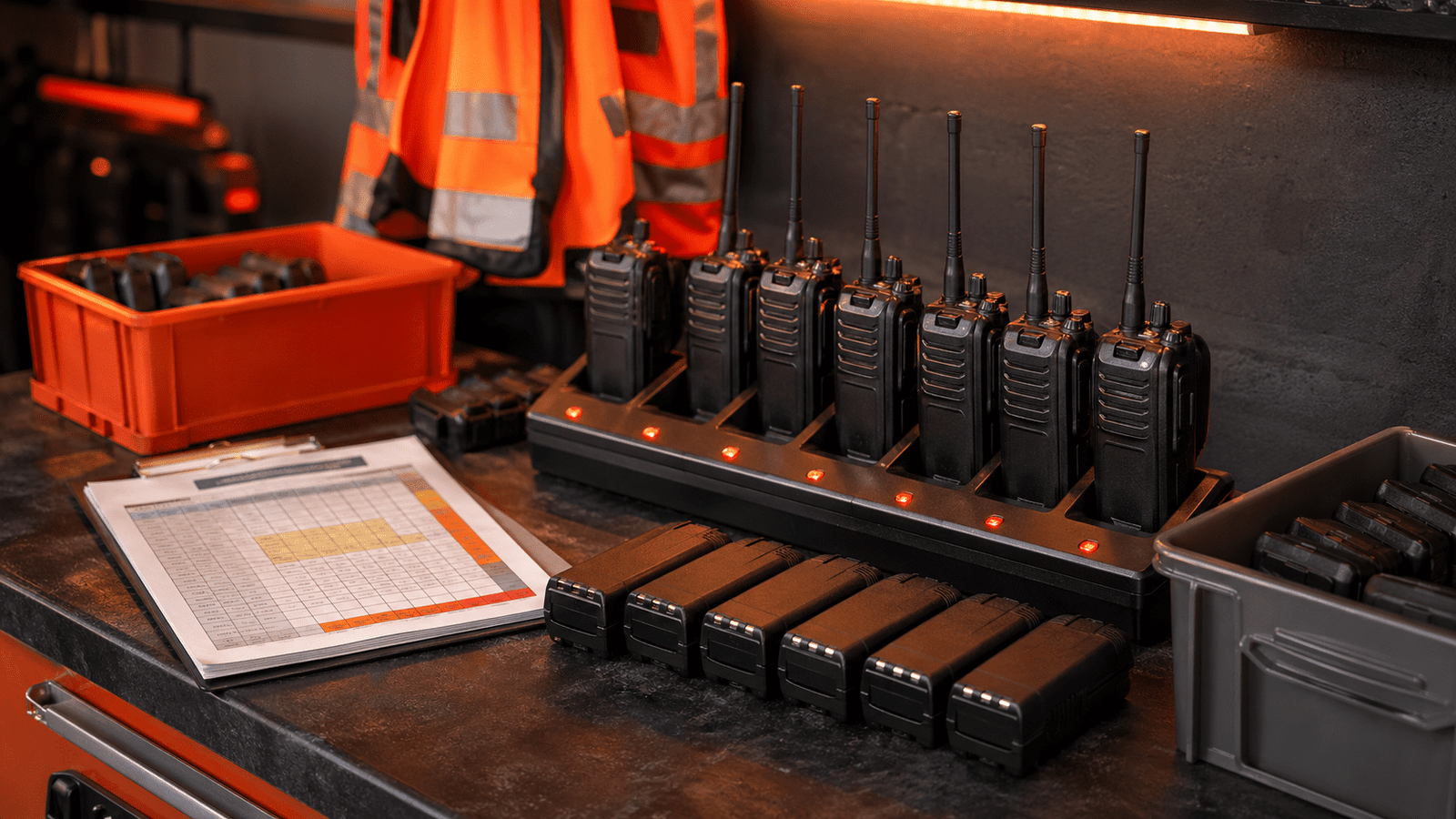
A walkie talkie battery can last very differently depending on transmit time, speaker volume, age of battery, charger quality, weather, and how often users talk. A guard who transmits often during patrol will drain a battery faster than a warehouse picker who only listens for short updates. A hot outdoor event site can also feel different from an indoor mall or hotel operation.
For Malaysian teams, the practical question is simple: can every critical user finish the shift, hand over the radio, and still keep emergency capacity available? If the answer is uncertain, the site needs a spare battery and charging plan, not only more radio units.
How many spare batteries should you plan?
For ordinary short shifts, a fully charged radio may be enough if the batteries are healthy and users follow charging rules. For 12-hour posts, overnight security, large events, construction sites, and emergency response roles, plan extra battery packs so the team can swap without taking a radio out of service.
- Count active users first, not just departments.
- Add relief users for lunch breaks, handover, and overtime.
- Add spare batteries for posts that must stay reachable at all times.
- Replace weak old batteries instead of building a larger plan around unreliable stock.
Battery planning by shift type
Battery planning is different for a compact retail team, a 24-hour guardhouse, a warehouse with multiple loading areas, or a three-day event. The table below gives a practical way to think about the starting quantity before Octogen checks your exact radio model, duty cycle, and site workflow.
| Operation type | Planning approach | What to watch |
|---|---|---|
| Short indoor shift | One radio per active user with disciplined overnight charging | Battery age, missed charging, and users sharing radios without logging handover |
| 12-hour security or facilities shift | One radio per post plus spare batteries for critical posts | Patrol frequency, emergency standby, and handover overlap |
| Warehouse, factory, or logistics yard | Plan by zones, supervisors, forklifts, loading bays, and relief users | High transmit use, noise, damaged batteries, and chargers hidden in the wrong area |
| Events, construction, and temporary sites | Add spare radio sets, spare batteries, and a visible charging station | Long operating days, outdoor heat, rain protection, and mixed user discipline |
How to set up a charging workflow
Use a central charging point for small teams and separate charging zones for large sites. Label the process in plain operational terms: ready, in use, and used. Supervisors should know which radios are assigned to which post, which batteries are weak, and when replacements are needed. This is especially useful for Kuala Lumpur, Klang Valley, Johor Bahru, Melaka, Penang, and other Malaysia sites where teams may run early starts, late closes, or weekend events.
- Keep chargers dry, ventilated, and easy to inspect.
- Do not mix old weak batteries with reliable new packs without marking them.
- Assign charging responsibility to a supervisor, not to whoever finishes last.
- For rental sets, confirm charger count, spare battery count, and return condition before the event starts.
Common Customer Questions
Real Deployment Notes
A weak battery can make a good radio look unreliable. Test and retire failing packs before adding more units.
If chargers sit far from the supervisor or guardhouse, users often skip the correct handover routine.
For events, confirm radio count, spare battery count, charger count, accessories, and return condition before deployment.
Common Customer Questions
How long does a walkie talkie battery last in a normal shift?
It depends on the radio model, battery age, talk time, speaker volume, and site conditions. For business planning, match battery capacity to the real shift length instead of relying only on brochure estimates.
Should I buy more radios or more spare batteries?
If user count is the problem, buy or rent more radios. If radios die before the shift ends, spare batteries and better charging workflow may solve the issue more directly.
Do event rentals need spare batteries?
Usually yes for long event days, outdoor heat, security posts, marshals, and command teams. Confirm spare battery and charger quantity before the event starts.
Why do some batteries become weak even after charging?
Batteries age, get overused, suffer from heat, or fail after repeated charge cycles. Weak batteries should be marked and replaced because they create unreliable radio coverage.
Can Octogen help plan batteries for Malaysia sites?
Yes. Octogen can advise radio count, spare batteries, chargers, rental sets, accessories, PoC radio, and site communication planning for Malaysian operations.
Ask Octogen About Your Site Coverage
Send Octogen your shift length, team size, site type, and current battery pain points. The team can advise whether you need more radios, spare batteries, chargers, rental sets, or a better operating workflow. Visit our website for more details.